 To Read More Editors
If you want to know how to start a habit that’s still standing three weeks from now, start smaller than feels reasonable. Most new habits don’t die because of laziness. They die because they’re too big, they have no fixed spot in the day, and nobody planned for the first bad Wednesday. This guide gives you a five-step method, a fill-in plan and a one-week setup you can begin tonight.
The short answer
Pick one habit and shrink it to a version you can do in under two minutes. Tie it to something you already do every day, like pouring coffee. Set out what you need the night before. Make one mark each time you do it. When you miss a day, do the tiny version the next day so one miss never turns into two.
Key takeaways
Start with one habit, never three.
The tiny version is the floor, not the goal; doing more is a bonus.
An anchor beats a reminder, because you never have to remember an anchor.
Friction is a design problem you fix the night before, not a willpower problem you fight in the moment.
One missed day is normal; two in a row is the start of a new pattern.
Why new habits fade in week two (and why it isn’t a character flaw)
Week one runs on novelty. You bought the notebook, told a friend, maybe downloaded an app. That energy is real, but it’s borrowed. By the second week it’s gone, and the habit has to stand on its own legs.
That’s where most habits fall over, for three plain reasons:
- It’s too big. “Work out for an hour” asks for an hour of time and an hour of willpower on your worst day, not your best one.
- It has no home in the day. “Sometime today” quietly becomes “not today.” A habit without a trigger has to be remembered, and memory is the first thing to go when you’re busy.
- There’s too much friction. Shoes in the closet, journal in a drawer, an app that needs a login. Every small step between you and the habit is a place to quit.
None of these say anything about who you are. They’re design problems. Design problems can be fixed, which is the good news hiding in every abandoned habit.
How to start a habit in five steps
Here’s the whole method in one line: make it tiny, tie it to something you already do, remove the friction, track it simply, and plan for the miss. Each step is small on purpose. Together they carry the habit through the weeks when motivation goes quiet.
Shrink it
Find the two-minute version.
Anchor it
Attach it to a daily habit.
Clear the path
Set it up the night before.
Mark it
One mark, one place.
Plan the miss
Never miss twice.
Step 1: Shrink it until it feels almost silly
Pick the smallest version of the habit that still counts. Not the goal, the first step. “Run three miles” becomes “put on running shoes and step outside.” “Read more” becomes “read one page.” “Meditate” becomes “sit down and take five slow breaths.”
Yes, it feels too easy. That’s the point. On a hard day, a tiny habit is still doable. On a good day, you’ll often keep going on your own. You’re not chasing results this week. You’re becoming the person who shows up.
Quick win
The two-minute test: if you can’t do it in under two minutes on your most tired evening, shrink it again.
Step 2: Anchor it to something you already do
Your day is already full of habits you never think about: making coffee, brushing your teeth, sitting down at your desk, plugging in your phone. These make perfect anchors, because they happen whether you feel motivated or not.
Write the new habit as one sentence and keep it where you’ll see it. Use the worksheet below.
Fill-in worksheet: my habit sentence
After I , I will .
The night before, I will set out .
If I miss a day, my smallest version is .
Examples: After I pour my coffee, I will write one line. After I close my laptop, I will put on my walking shoes. After I plug in my phone at night, I will read one page.
Choose an anchor that happens every day, at roughly the same time, without fail. A vague anchor like “after lunch,” when lunch moves around all week, gives you a vague habit.

Step 3: Clear the path the night before
Friction is anything that sits between you and the first move. The trick is to deal with it when you have nothing to lose, the evening before, rather than in the moment, when part of you is shopping for an excuse.
- Leave the book on your pillow, not on the shelf.
- Put your shoes by the door with the socks tucked inside.
- Fill a water bottle and stand it next to the coffee maker.
- Open the notebook to a blank page and leave the pen on top.

It works in reverse too. To make a habit harder, add steps: move the app off your home screen, keep snacks in a high cupboard, charge your phone in the kitchen.
Tip
Make the first step visible. If you can see the cue from where you’ll be standing when the anchor happens, you’ve done most of the work already.
Step 4: Track it with one mark a day
You don’t need an app with streaks, badges and push alerts. You need one place where you make one mark each time the habit happens. A paper calendar on the fridge, a line in a planner, a dot inside the notebook cover.
Seeing a row of marks is quietly satisfying, and it turns “did I do it?” into a glance. The Healthy Ireland guide to creating a new habit makes the same practical suggestions: start small, link it to an existing routine, prepare your surroundings and track your progress.

Note
Keep the tracking smaller than the habit. If logging takes longer than doing, logging will be the first thing you drop.
Step 5: Plan for the day you miss
Every habit gets missed. A sick kid, a late train, a bad night’s sleep. The miss itself does little damage. The damage comes from the story you tell afterward: “I broke the streak, so I guess I failed.” That story ends more habits than any busy week.
There’s some reassurance in the research here. A review in the British Journal of General Practice, Making health habitual, describes repetition in a consistent context as the core of habit formation and notes that missing the occasional opportunity did not seriously impair the process in the study it discusses.
Important
Decide your rule now, before it happens: never miss twice. The day after a miss gets the tiniest version, no matter what. One page. One breath. Shoes on, then back inside if you must.
Free download
10 Friction Cards
Ten printable prompts for the exact moment a habit stalls: tired, bored, busy or “later.” Keep one by your anchor.
Get the free cardsChoose the right anchor: a quick decision table
Not every anchor fits every habit. Morning anchors are steadier for most people, but evenings suit habits that wind you down. Use this table to match the habit to the slot.
| Anchor | Works well for | Watch out for |
|---|---|---|
| Morning coffee or tea | Writing, planning, water, stretching | Weekends when you sleep in |
| Arriving at your desk | Daily top task, inbox cleanup, one learning page | Days you work from somewhere else |
| Closing the laptop | Walking, a tidy-up, a quick workout | Late meetings that move the end of the day |
| Brushing your teeth at night | Flossing, a gratitude line, setting out tomorrow’s cue | Being too tired for anything with steps |
| Plugging in your phone | Reading one page, a phone-free wind-down | Charging it next to the bed |
If your days are unpredictable, pick an anchor that travels with you, like brushing your teeth, rather than one tied to a place or a schedule.
Your first seven days, planned
Want to start this week? Here’s a simple plan. Each day has one small job, and none of them take more than ten minutes.
| Day | Your one job | Time |
|---|---|---|
| Day 1 | Pick one habit. Write the tiny version and fill in the worksheet sentence. | 5 min |
| Day 2 | Set out the cue the night before. Put the tracking sheet somewhere visible. | 5 min |
| Day 3 | Do the tiny version. Make one mark. Stop there, even if you feel like more. | 2 min |
| Day 4 | Do it again. Write down what almost stopped you. | 2 min |
| Day 5 | Fix one friction point you noticed yesterday. | 5 min |
| Day 6 | Do the habit. If you want to, do a little more. | 2+ min |
| Day 7 | Review: what worked, what to change, what to keep. | 10 min |
Day seven matters more than it looks. It’s where you bend the habit to fit your real week, not the week you imagined when you started. Change one thing, not five.
For the moment a habit stalls
The 45 Friction Cards
✓ 45 short prompts for tired, bored, busy and “I’ll do it later” moments.
✓ Part of the Start Ugly Kit, the full toolkit for starting before you feel ready.
See the cardsWhat a habit that sticks looks like in real life
Here’s a composite example, built from situations many readers will recognize. Call her Maya. She wanted to journal every morning, and her first plan was twenty minutes of writing before work. It lasted four days. Then a busy week arrived, the notebook went into a drawer, and three weeks slipped by.
Her second try was smaller. The habit became “after I pour my coffee, I write one sentence.” The notebook stayed open on the kitchen counter with the pen on top. She marked each day with a dot inside the cover.
Some mornings she wrote one sentence. Some mornings she filled a page. When she missed a Saturday, she wrote one line on Sunday and moved on. Her mornings were just as rushed. What changed was the design.
“Don’t ask for more willpower. Ask for a smaller first step.”
The To Read More rule for starting
How to start a habit when you’re running on empty
Sometimes the habit isn’t the problem. The tank is. If you come home drained most evenings, a new habit lands as one more demand, and it’ll lose to the couch every time.
In that case, start with energy, not effort. Move the habit to a morning slot, or pick one that gives energy back, like a ten-minute walk or a set screen-off time. Make the tiny version even tinier for the next few weeks.
If that sounds familiar, read what to do when you’re too tired to do anything first. And if your mind keeps running at night, why your brain won’t switch off at night covers the evening side. A habit built on a rested week is far easier to keep.
Warning
If exhaustion, low mood or poor sleep has lasted for weeks, it’s worth talking to a doctor or a qualified professional. A habit plan is a tool for ordinary tiredness, not a replacement for proper support.
When this method doesn’t apply
Tiny habits are a great default, but they aren’t the answer to everything. Be honest about which situation you’re in:
- Breaking a dependency. Stopping drinking, smoking or gambling is a different job from starting a walk. Speak to a doctor or a support service rather than relying on a habit trick.
- A one-off project. Filing taxes or clearing the garage is a task, not a habit. Schedule it, break it into steps and do it once.
- A habit someone else controls. If your shifts change every week, anchor to something personal, like waking up or brushing your teeth, not to a clock time.
- A habit you don’t actually want. If you’re forcing it because you feel you should, pick a different habit that serves the same goal. A habit you resent rarely survives a busy month.
Habit, procrastination or resolution? Pick the right tool
These three feel similar, but they’re different jobs. A habit is something you want to do again and again. Procrastination is usually one specific task you keep pushing back. A resolution is a big goal tied to a fresh start.
If you’re fighting one task you know you should do and still avoid, read how to stop procrastinating when you know what to do. If you’ve tried the big-start approach before, our guide to resolutions that actually last explains why an ordinary Tuesday works just as well as a fresh start.
For the bigger picture, a weekly Sunday reset routine gives your habits a regular check-in, so small slips get noticed before they turn into a lost month.
Common mistakes when starting a new habit
1. Starting three habits at once
Each new habit needs attention for the first few weeks. Three at once splits that attention three ways. Pick one, keep it until it feels automatic, then add the next.
2. Waiting to feel motivated
Motivation tends to show up after you start, not before. The tiny version exists so you can begin without it. Do the two-minute version and let the feeling catch up.
3. Treating a miss as a verdict
A missed day is information. Ask “what got in the way?” instead of “what’s wrong with me?” Then fix the friction and do the smallest version tomorrow.
4. Growing it too fast
Once the habit starts working, it’s tempting to double it. Wait until the tiny version feels boring and automatic, then add a little: one page becomes three, not thirty.
5. Picking an anchor that moves
“After lunch” or “when I get a free moment” isn’t an anchor. Choose something that happens every single day, in the same order, whatever your mood.
Make the weekly review easy
The Sunday Reset
✓ A weekly reset for reviewing the week and setting up the next one in one sitting.
✓ Want the full starting toolkit? The Start Ugly Kit is the better deal for building a habit from scratch.
See The Sunday ResetPrefer the bundle? See the Start Ugly Kit, the starting toolkit The 45 Friction Cards belong to.
How to start a habit: quick answers
What is the easiest way to start a new habit?
Make it tiny and attach it to something you already do every day. Write it as “After I [current habit], I will [new habit],” set out what you need the night before, and stop after the tiny version for the first few days. Small and anchored beats big and motivated, because it still works on the days you feel tired, busy or distracted.
How long does it take to form a habit?
There’s no single number of days that fits everyone. It depends on the person, how complex the habit is and how steady your routine is. A more useful test is whether the habit is getting easier and needing less thought. When you find yourself doing it without deciding to, it’s well on its way, whatever the calendar says.
What should I do if I miss a day?
Treat one miss as normal and follow a simple rule: never miss twice. The next day, do the smallest possible version of the habit, even if it takes thirty seconds, so the pattern keeps going. Then ask what got in the way and remove that friction. A missed day only becomes a problem when it turns into a missed week.
Should I start more than one habit at a time?
Start with one. Each new habit needs attention and setup in its first weeks, and several at once usually means none of them get enough. When the first habit feels automatic and needs little effort, add the next one, ideally anchored right after the first. Habits stacked one at a time tend to hold up better than a full new routine.
Do I need an app to track a habit?
No. A paper calendar on the fridge, a line in a planner or a dot inside a notebook cover works just as well for most people. Pick whatever takes less time than the habit itself. If logging feels like a chore, simplify it. The goal of tracking is a quick, honest answer to one question: did I do it today?
What is the best time of day to start a habit?
The best time is the one tied to a reliable anchor. For many people that’s the morning, because the start of the day is more predictable than the evening. Habits that help you wind down, like reading or setting out tomorrow’s clothes, can suit the evening better. Choose the slot where the anchor happens every single day.
Bottom line
Learning how to start a habit comes down to design, not willpower: make it tiny, anchor it, clear the path, mark it and never miss twice. Tonight, fill in the worksheet sentence and set out your cue for tomorrow. For more guides like this one, browse the To Read More journal or start with resolutions that actually last.
This article is general information, not medical or psychological advice. Examples are composites. If a habit involves your health, a dependency or a medical condition, talk to a qualified professional.
Sources
Healthy Ireland, gov.ie: Creating a new habit
Gardner, Lally and Wardle, British Journal of General Practice: Making health habitual: the psychology of habit-formation and general practice
Want the exact words?
12 word-for-word scripts for money, work, family and saying no. Free, by email.

The Start Ugly Kit
You know exactly what to do. And still don't.
- Start Ugly
- Nobody’s Coming
- The Scroll
- The 45 Friction Cards
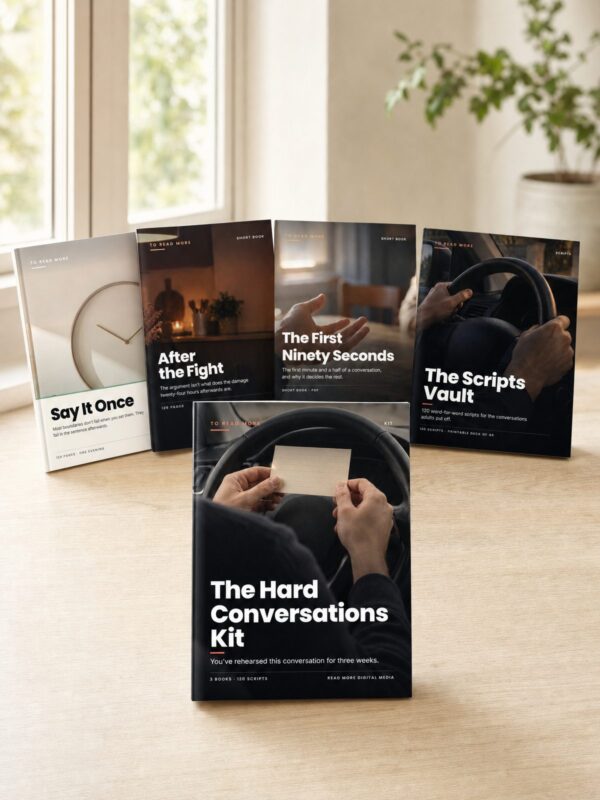
The Hard Conversations Kit
You have rehearsed this conversation for three weeks.
- Say It Once
- After the Fight
- The First Ninety Seconds
- The Scripts Vault

The Money Reset Kit
Paid on Friday. Broke by Tuesday.
- Broke by Friday
- The Money Reset Workbook
- The Life Admin Binder

The Quiet Mind Kit
The day ended hours ago. Your head didn't get the message.
- The 3AM Mind
- The Empty Tank
- The Overthinker’s Workbook