 To Read More Editors

Most new year’s resolutions don’t fail because people are lazy. They fail because they’re designed for the version of you who exists on the first of January: rested, motivated and full of plans. By the second week of the month, the normal you is back, with a full inbox, a tired evening and a resolution that was never built for real life.
This guide explains why new year’s resolutions fail so often and gives you nine simple ways to build ones that survive past January, with real examples you can copy.
Quick answer: pick one resolution instead of five, shrink it until it feels almost too easy, attach it to something you already do every day, remove whatever makes it awkward to start, decide in advance what the bad-day version looks like, and plan for the dip in February. Small and boring beats big and abandoned.
Why new year’s resolutions fail
Look at most abandoned new year’s resolutions and you’ll find the same five problems:
- Too big: “Go to the gym five times a week” from a standing start.
- Too vague: “Be healthier”, “save more”, “read more”. You can’t do a vague thing on a Tuesday.
- Too many at once: five changes competing for the same tired evenings.
- Built on motivation: motivation is high on the first and gone by the twelfth. Plans that need it collapse when it leaves.
- Full of friction: the kit isn’t ready, the time isn’t set, the first step isn’t clear. Every small obstacle is a reason to start tomorrow.
None of these are character flaws. They’re design flaws, and design can be fixed.
1. Pick one resolution, not five
Write down every change you’d like to make. Then choose the one that would make the others easier. Sleeping better often makes exercise easier. Getting on top of money often makes everything less stressful. One resolution done properly beats five done for a week.
2. Make it almost embarrassingly small
Shrink the resolution until you could do it on your worst day. Not “run three times a week” but “put on running shoes and walk to the end of the street”. Not “write a book” but “write 100 words after breakfast”. The goal in January isn’t results. It’s showing up often enough that it becomes normal.
| Typical resolution | Small version that survives |
|---|---|
| Get fit | A 10-minute walk after lunch on weekdays |
| Save money | Move a fixed small amount to savings the day you’re paid |
| Read more | Ten pages before bed, phone charging in another room |
| Be more organised | One 30-minute reset every Sunday evening |
| Start the side project | One ugly first draft, 20 minutes, twice a week |
This is the whole idea behind Start Ugly: begin with a version so rough and small that there’s nothing to be afraid of.

The Start Ugly Kit
Start Ugly, Nobody’s Coming, The Scroll and The 45 Friction Cards in one download: for when you know exactly what to do and still don’t do it. $39 instead of $74 bought separately.
See the Start Ugly Kit →3. Attach it to something you already do
New habits stick better when they have an anchor: “After I pour my morning coffee, I write 100 words.” “After I brush my teeth at night, I put my gym bag by the door.” The existing habit becomes the reminder, so you don’t have to rely on remembering.
4. Remove the friction before you need willpower
Ask: what will make this awkward to start on a cold, tired evening? Then fix it in advance. Lay the clothes out. Put the book on the pillow. Delete the app from your home screen. Set up the automatic transfer now, not “when I get round to it”. Each tiny obstacle you remove is a decision you won’t have to win later. If you’re not sure what’s stopping you, the free friction finder takes two minutes, and our 10 free friction cards name the most common blocks and how to get round them.
5. Decide the bad-day version now
There will be days when the plan doesn’t happen: illness, late shifts, a sick child, a terrible night’s sleep. Decide now what the minimum looks like on those days. Two minutes of stretching instead of the full workout. One page instead of ten. Doing the small version keeps the chain going, and the chain matters more than any single day.
6. Track it with one simple mark
A paper calendar on the fridge and a cross for every day you do it. That’s enough. Seeing a row of crosses is quietly motivating, and a gap tells you something useful: what happened that day, and how can you make it easier next time?
7. Plan for the February dip
Almost everyone wobbles a few weeks in, when the novelty wears off and the weather is grim. Expect it. Put a note in your calendar for early February: “This is the dip. Do the small version.” Knowing it’s coming takes away the feeling that you’ve failed.
8. Review your new year’s resolutions once a month
On the last Sunday of each month, spend ten minutes asking three questions: what worked, what got in the way, and what one change would make next month easier? Adjust the plan rather than abandoning it. Resolutions that get reviewed get kept. A good place to start is with these end of year reflection questions, then plan the year on one page.
9. Start before the first of January
You don’t need a new year to begin. Starting your new year’s resolutions in December means the awkward first week happens while life is already irregular, and by January the habit is no longer new. The date on the calendar is a nice moment, not a requirement. If you keep putting the start off, read how to stop procrastinating when you already know what to do.
For a deeper look at how habits form, the Greater Good Science Center publishes accessible, research-based articles on behaviour change and wellbeing.
New year’s resolutions: quick answers
Why do most new year’s resolutions fail?
Usually because they’re too big, too vague or too many, and they rely on motivation that fades within weeks. Making them smaller, specific and attached to an existing routine helps them last.
What is a good new year’s resolution?
One you could do on your worst day. Specific, small and tied to a time or an existing habit: “a 10-minute walk after lunch on weekdays” rather than “get fit”.
How many resolutions should I make?
One is best, two at most. Add another only once the first feels automatic, which often takes a couple of months.
What if I’ve already broken my resolution?
Start again tomorrow with the bad-day version. Missing a day doesn’t undo the days you’ve done. Missing the restart is what ends a resolution.

The 45 Friction Cards
A printable card deck that names the exact thing stopping you from starting, with one small move for each. Pull a card, do the move, start ugly.
See the 45 Friction Cards →Planning next year? The three tools that carry a plan from the page into ordinary weeks are on one page: plan next year with To Read More.
Want the exact words?
12 word-for-word scripts for money, work, family and saying no. Free, by email.

The Start Ugly Kit
You know exactly what to do. And still don't.
- Start Ugly
- Nobody’s Coming
- The Scroll
- The 45 Friction Cards
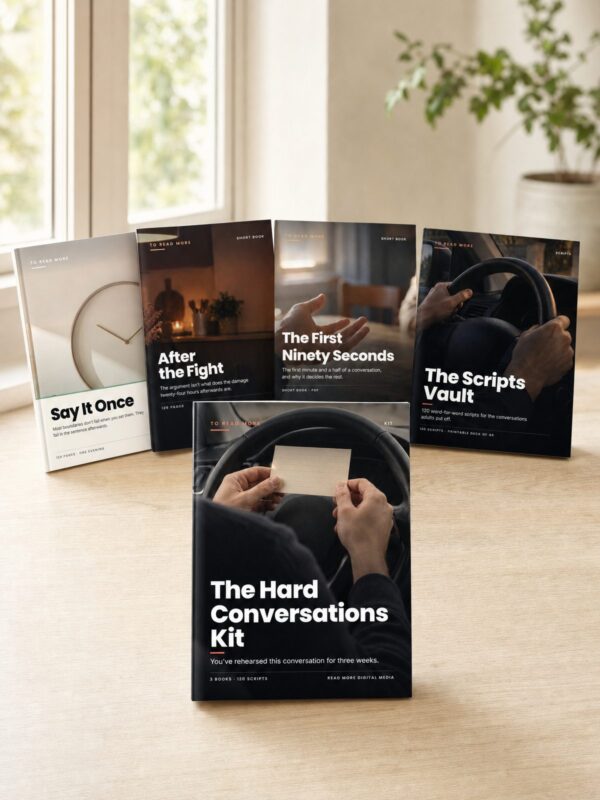
The Hard Conversations Kit
You have rehearsed this conversation for three weeks.
- Say It Once
- After the Fight
- The First Ninety Seconds
- The Scripts Vault

The Money Reset Kit
Paid on Friday. Broke by Tuesday.
- Broke by Friday
- The Money Reset Workbook
- The Life Admin Binder

The Quiet Mind Kit
The day ended hours ago. Your head didn't get the message.
- The 3AM Mind
- The Empty Tank
- The Overthinker’s Workbook