 To Read More Editors

Holiday stress has a way of starting before the holidays do. The calendar fills up, the to-do list doubles, money gets tighter and the expectation that everything should feel magical sits on top of it all. If you were already tired in November, December can feel like running a marathon on an empty tank.
This guide gives you nine practical ways to cope with holiday stress that don’t require a spa day or a personality change: how to cut the list, protect your sleep, share the load and keep the few moments that actually matter.
Quick answer: write every holiday task down, cut or simplify a third of it, pick three moments that matter most, protect your wake-up time, book two empty evenings a week, and say no to one thing this week. Holiday stress is mostly an arithmetic problem: too much load, too little recovery. Change the numbers and the feeling follows.
This is general information about everyday stress, not medical advice. If low mood, anxiety or exhaustion lasts for weeks, or you have thoughts of harming yourself, please speak to a doctor or contact a local crisis line today.

What holiday stress actually is
Holiday stress isn’t a sign you’re bad at Christmas. It’s what happens when four things change at the same time:
- More tasks: gifts, food, cards, travel, events, school plays, end-of-year work deadlines.
- Less time: the same 24 hours, with more evenings already booked.
- Higher expectations: the idea that everything should be special, and that you’re the one who makes it special.
- Less recovery: later nights, more sugar and alcohol, fewer quiet hours.
You can’t remove the season. You can change the load and protect the recovery. That’s what the nine steps below do.
1. Write the whole list, then cut a third
Most holiday stress comes from a list you’re carrying in your head. Put it on paper: every gift, every event, every errand, every “I should”. Then sort each line into one of three columns.
| Keep | Simplify | Drop |
|---|---|---|
| Things you or the people you love would genuinely miss | Homemade becomes shop-bought, three courses become one, ten cards become a group message | Things you do only because you did them last year |
Aim to move at least a third of the list out of the “keep” column. Nobody remembers whether the napkins matched.
Free download
12 free word-for-word scripts
The exact words for the conversations you keep putting off. A short PDF, sent to your inbox.
Free. Unsubscribe anytime.
2. Pick the three moments that matter
Ask yourself: when I look back on this season, what are the three moments I want to have been present for? Maybe it’s the school nativity, one long lunch with friends and a slow morning on the 25th. Protect those. Everything else is allowed to be ordinary.
3. Protect your sleep, starting with the wake-up time
Late nights are part of the season, but a wildly changing wake-up time makes holiday stress worse fast. Keep the alarm roughly the same most days, even after a late evening. Stop work emails an hour before bed and give your brain a short wind-down: dim lights, a paper book, a list of tomorrow’s three tasks so they’re not looping in your head. Our free wind-down planner builds a simple evening routine around your bedtime.
4. Book recovery like an appointment
Recovery doesn’t happen in the gaps, because in December there are no gaps. Put two empty evenings a week in your calendar and treat them like any other commitment. If someone asks, you’re busy. You are: you’re recovering. If you’re already at the point where you’re too tired to do anything at all, start with what to do when the week took everything.
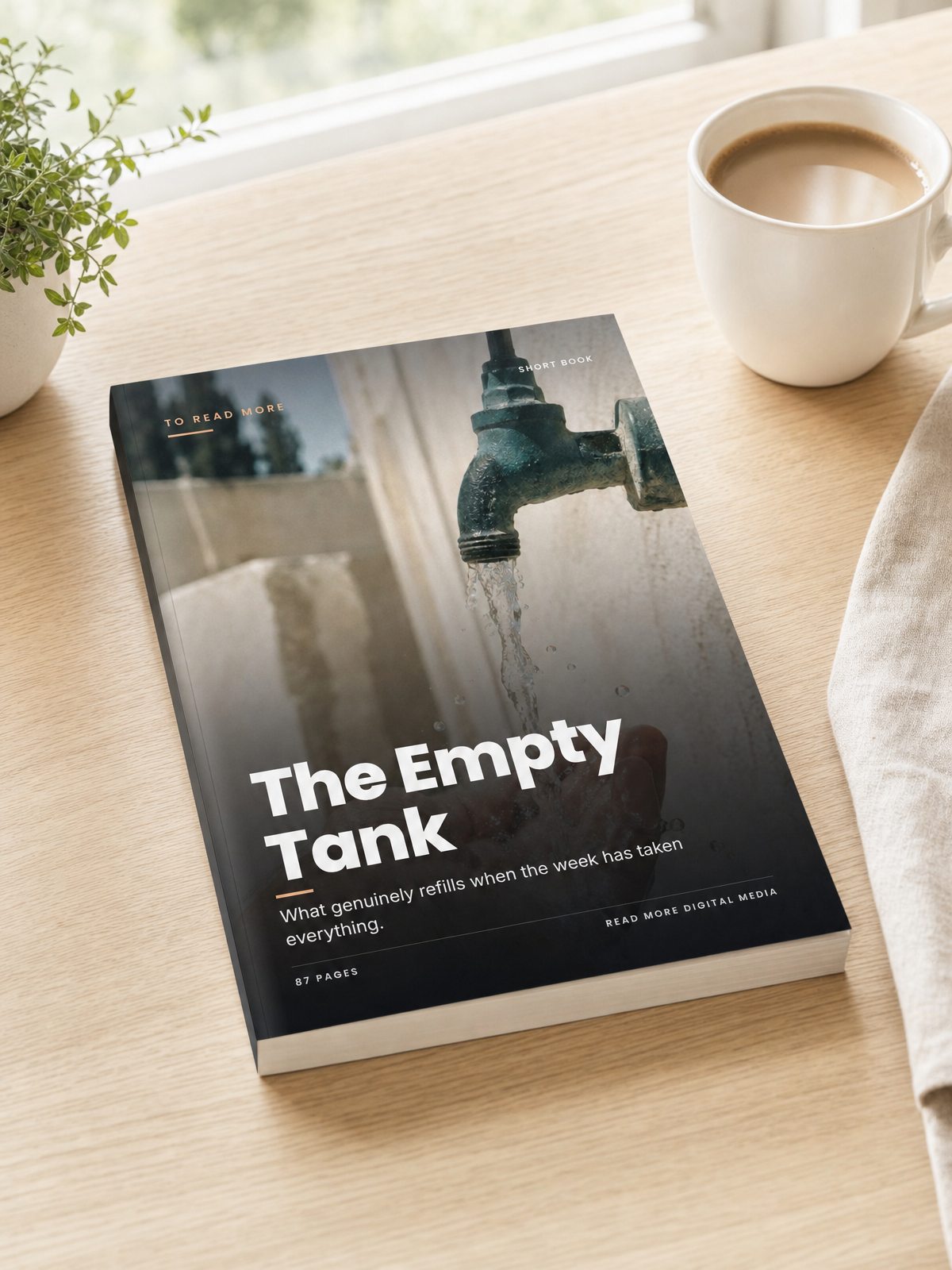
The Empty Tank
A short book for when the week took everything: how to tell tired from depleted, what actually refills the tank, and how to stop running on fumes through the busiest weeks of the year.
See inside The Empty Tank →5. Lower the bar on purpose
Decide in advance where “good enough” is good enough. Shop-bought dessert. Gift cards for the teenagers. Paper plates on the second day. A lot of holiday stress comes from quietly holding yourself to a standard nobody else has asked for. Choose one or two things to do beautifully and let the rest be simple.
6. Share the load, out loud
Many people carry the planning for an entire household without anyone noticing it’s a job. Make it visible, and ask for specific help.
Say it like this“I’m doing too much of the Christmas planning on my own. Can you take the food shop and the presents for your side of the family?”
Specific beats general. “Can you help more?” gets a yes and nothing changes. “Can you book the train tickets by Friday?” gets done.
7. Say no to one thing this week
Every yes in December costs an evening. Look at the next seven days and cancel or decline one thing that isn’t in your top three. One no a week can cut a surprising amount of holiday stress. You don’t need a long reason: “I can’t make it this time, but have a lovely evening” is enough. If family events are the hardest part, these calm things to say to difficult family help.
8. Keep money stress in its own box
Money worries leak into everything. Give them a time and a place instead: one sitting, one plan, one running total. Our step-by-step Christmas budget guide shows you how to set a number you can pay without borrowing against January, so you’re not doing mental arithmetic at every checkout.
9. A 10-minute daily reset
When you can’t take a day off, take ten minutes. Same time each day, phone in another room:
- Two minutes outside or by an open window.
- Three minutes writing down everything in your head, without sorting it.
- Three minutes picking the one task that would make tomorrow easier.
- Two minutes doing nothing at all.
It sounds too small to matter. That’s why people actually do it. A longer weekly version is in the Sunday reset routine.
When holiday stress is more than stress
The season can be especially hard if you’re grieving, lonely, caring for someone, or already struggling with your mental health. If you notice that low mood, worry or exhaustion has lasted for weeks, that you’ve stopped enjoying things you usually like, or that you’re relying on alcohol to get through, that’s a reason to talk to a doctor, not to try harder. The NHS mental health pages list signs to look out for and where to find support.
Holiday stress: quick answers
Why do the holidays make me so stressed?
Because the load goes up while recovery goes down: more tasks, less time, higher expectations and less sleep all at once. Holiday stress is a normal response to that combination, not a personal failing.
How do I relax during the holidays when there’s so much to do?
Cut the list first, then book short, protected recovery time: two empty evenings a week and a 10-minute daily reset. Relaxing works better when it’s scheduled rather than hoped for.
How can I reduce Christmas stress with family?
Plan the day’s shape in advance, decide which topics you won’t discuss, set a leaving time and arrange your own way home.
Is it normal to feel sad at Christmas?
Yes, many people do, especially after a loss or a hard year. If the sadness is heavy or lasts well beyond the season, talking to a doctor or counsellor is a good next step.
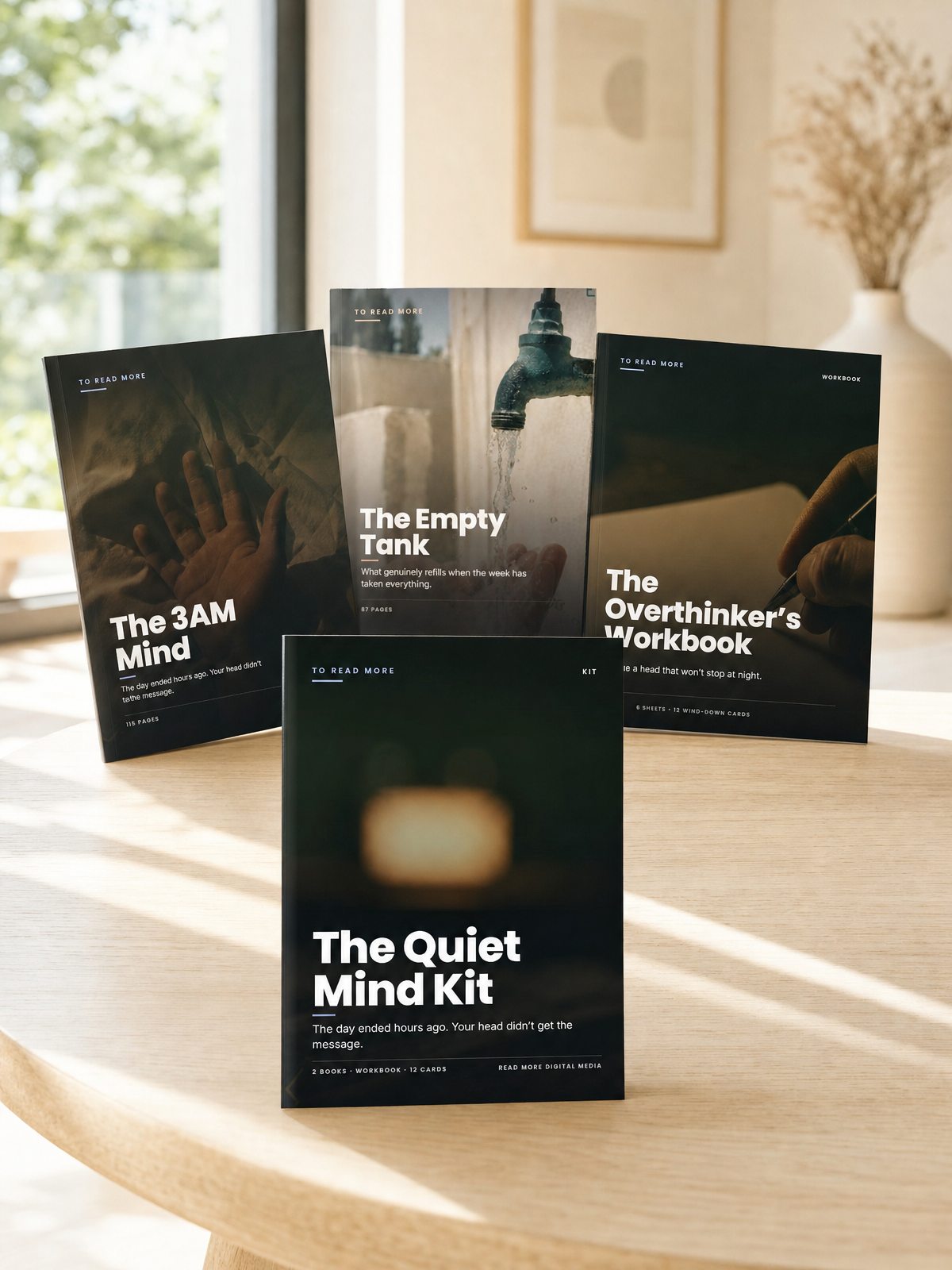
The Quiet Mind Kit
The 3AM Mind, The Empty Tank and The Overthinker’s Workbook in one download: for evenings when the day has ended but your head hasn’t. $39 instead of $57 bought separately.
See the Quiet Mind Kit →📌 Save it for later
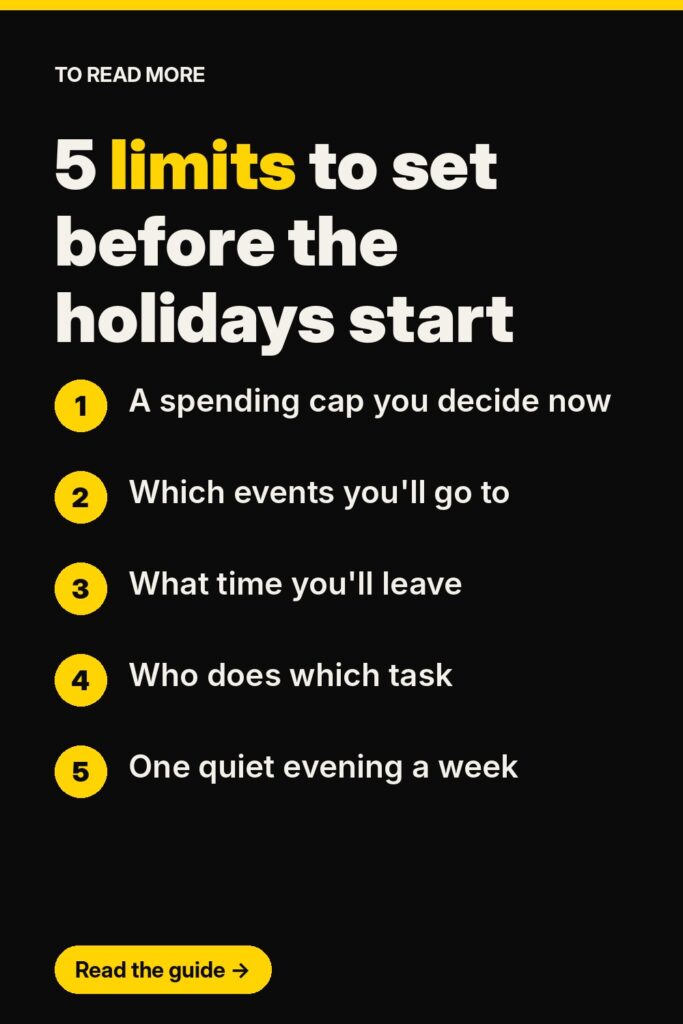
Want the exact words?
12 word-for-word scripts for money, work, family and saying no. Free, by email.

The Start Ugly Kit
You know exactly what to do. And still don't.
- Start Ugly
- Nobody’s Coming
- The Scroll
- The 45 Friction Cards

The Hard Conversations Kit
You have rehearsed this conversation for three weeks.
- Say It Once
- After the Fight
- The First Ninety Seconds
- The Scripts Vault

The Money Reset Kit
Paid on Friday. Broke by Tuesday.
- Broke by Friday
- The Money Reset Workbook
- The Life Admin Binder

The Quiet Mind Kit
The day ended hours ago. Your head didn't get the message.
- The 3AM Mind
- The Empty Tank
- The Overthinker’s Workbook